This blog is about a subject I have very little knowledge of, but get very excited about all the same. Some time ago I bought a book called The Lost Rainforests of Britain, by Guy Shrubsole. Not the sort of book I usually chose (I like high body counts, or some romance) but something drew me to it, and I loved it. I cannot guarantee all my facts are correct, it was a while ago that I finished the book, but hopefully my enthusiasm will lead you to find one, and enjoy their beauty.

Did you know that at one time, the UK had temperate rainforests all along the west coast, spreading from Cornwall, through Wales and up into Scotland. We still have the perfect climate for these rainforests, but over the years we have done our best to destroy them. The Victorians stripped them bare, for the ferns which grew there. Much better to have ferns in your house, than where they belong – I don’t think! Many were simply cut down, to make way for grazing sheep and, in Scotland, they are under attack from the sheer number of deer, which have been introduced and bred for hunting. A part of our natural world destroyed just so rich people can go out shooting animals for fun.
Back when we had plentiful temperate rainforests, we also had elk, boar, lynx and wolves, but now only boar remain. Beavers have been re-introduced, and I recently read an article talking about reintroducing lynx, so maybe one day we will be able to restore these animals, and start to restore some of our rainforests. So, while we are worrying about the destruction of rainforests across the globe, maybe it’s time to start worrying about our own.
There are still pockets of these rainforests left, and I was so captivated by the photos in Guy’s book, I was determined to see some of them for myself, as part of our travels. The photos show vibrant green trees, acid green moss, soft ferns and a myriad of different fungi. I confess I cannot tell one lichen from another, or name any fungi, but I still wanted to see them. The book, helpfully, has a map of where they are, and descriptions of how to get to them. Some of them would take a braver person than me to access, but not all of them, and I would love to see as many as possible.
However, despite being armed with The Lost Rainforests of Britain, the first one I saw was in Ireland. I was visiting my dad and telling him all about the book (no idea if he was interested, but he now gets an up date when I do see one) when he told me there was one not far from him. He knew about it because of a news article when Chris Packham visited to see it. Neil looked resigned, and off we went.

Near Lismore, we found a rocky river, flowing under a bridge, and surrounded by rainforest. Surrounded is a bit of an exaggeration, these are more like pockets of loveliness, rather than forests as we imagine them. It was beautiful. On a hot August day, it was cool and peaceful. The trees were in leaf, but as well as their usual greenness, their trunks and branches were covered in moss of various shades, like furry coats. In addition to the moss, ferns grew off of the branches. We were both enchanted, and it was such a peaceful space just to be in.


“What really marks out a temperate rainforest, however, isn’t the dominant species of tree, but rather the other plants growing on them. Epiphytes – plants that grown on other plants – are a key indicator of a rainforest.” (The Lost Rainforests of Britain – Guy Shrubsole)

The next time I found a very tiny slice of rainforest heaven was staying with friends in Wales earlier this year. They have a wonderful home, with a wild garden, bordered by a river. You can cross a bridge into woodland on the other side and there are a handful of trees, covered in moss and with ferns growing on them. There are only a few, but it was a perfect place for them, damp, shaded by the trees, and relatively untouched. It was so peaceful and a lovely surprise.


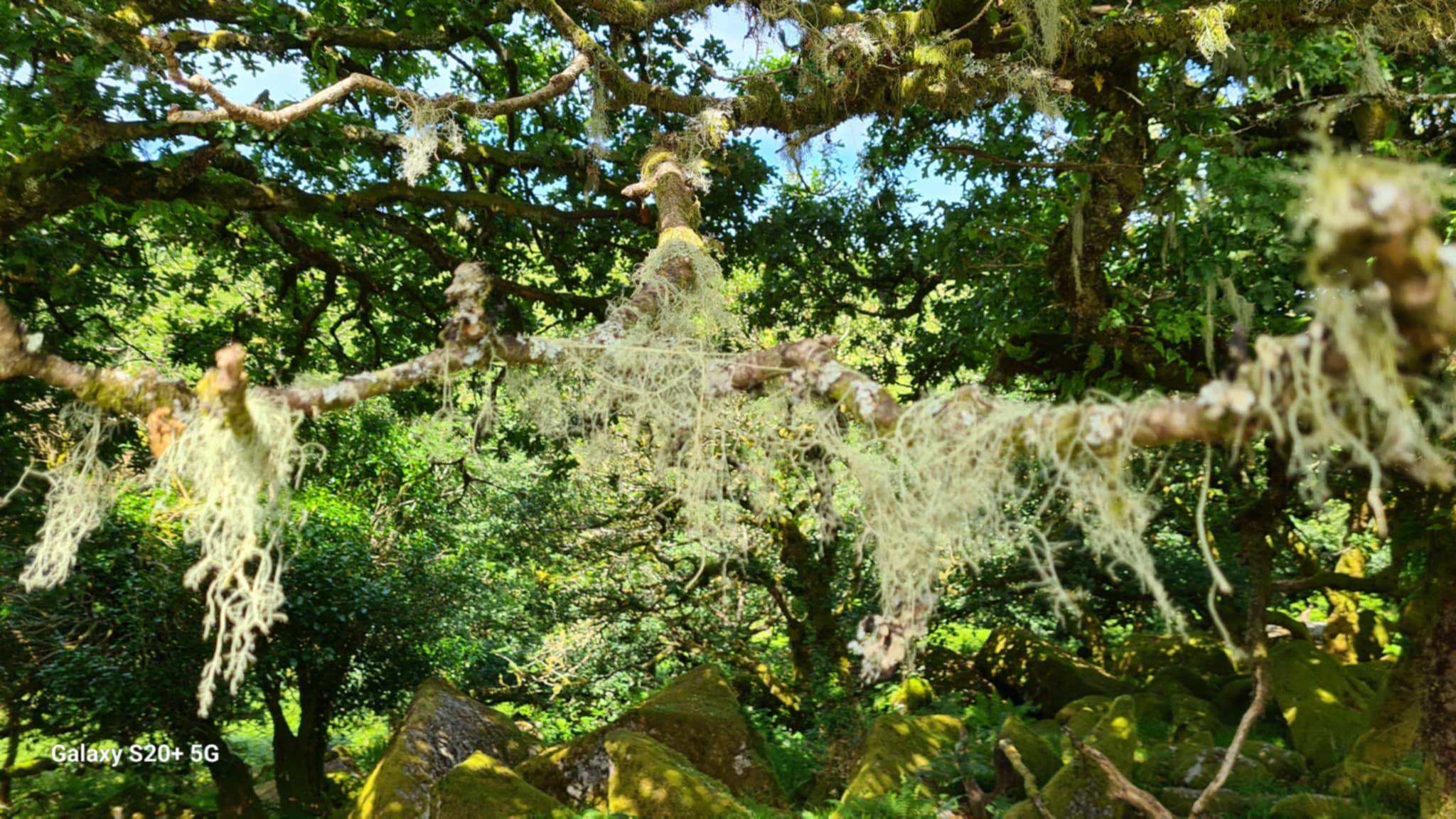
A couple of weeks ago, we found ourselves in Devon, and so I put a visit to Wistmans Wood on the itinerary. There are pictures of the wood in Guy’s book, and it is relatively easy to access. Wistmans wood is an oak woodland, but not oak trees as we normally see them. These are not towering giants, but are stunted, twisted and gnarled, like an old people, weighed down by the years and all the more lovely because of it.

It was a beautiful sunny day, but I can’t help feeling these woodlands would be even better in the rain. The wood is not fenced off, but polite signs ask walkers to stay on the edges, so as not to damage the precious habitat. It was a busy day for walkers, but no one gave in to the temptation to go in, which was great to see. Against the odds, Wistmans Wood has actually doubled in size in the last century, due to grazing restrictions. It is still very small, as woodlands go, but if one can regrow, hopefully more of them can be protected in the same way.


And it was very tempting. The ground was made up of huge boulders, the trees growing in-between them. Despite it being really dry, under the low canopy of the oaks, everything was green: the tree trunks, the branches and the rocks. It was covered in moss and ferns grew everywhere, and on everything. There was also horse hair lichen hanging from branches. It must have been lovely and cool under the branches, with the sun just getting through the canopy, but I had to content myself with sitting on the edge staring in. It reminded me of a promise I made to myself when we started this adventure. A promise to just sit and be, no talking, no phone, no book, just nature. I haven’t been doing enough of this lately, but the edge of a temperate rainforest was definitely a perfect place for a quiet reset.

It seems I can combine my new love for these slices of heaven, with my love of books. Wistmans Wood is thought to have inspired The Hound of The Baskervilles; the welsh rainforests are the site of a legendary battle in The Mabinogion, next on my reading list and Wordsworth took inspiration from the rainforests in the Lake District. Maybe I will have to use their otherworldly charm to weave into a story about my grandchildren.


Leave a Reply